How to play
Epoch Street is a board game about walking a town, buying shops, holding stock and growing your net worth. Get your net worth up to the goal amount, then reach a bank, and you win.
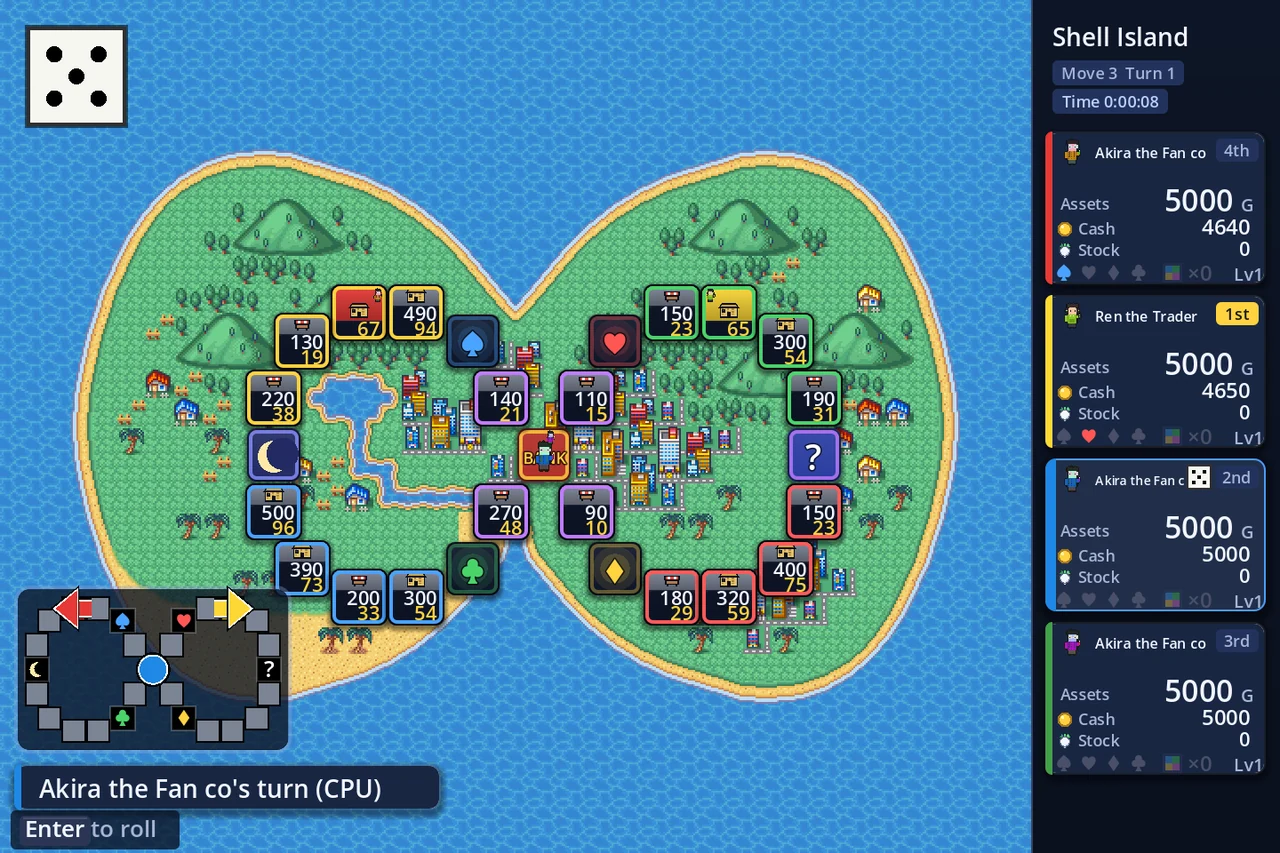
This guide covers an ordinary Standard match. For the settings themselves, see "Rule settings" and "Legacy and Modern".
0. First, get yourself a board
Epoch Street ships with no boards. You get the boards you play on from Online on the main menu (free, and no account is needed). A board you drew yourself in the board editor works too.
- Choose Online on the menu
- Pick a board from the list and install it
- Back on the menu, that board is now one you can play
With no boards at all, the board list says "You have no boards yet". Pressing Enter there takes you straight to Online.
1. Starting a match
- Press any key on the title screen to reach the menu
- Choose Single player (everyone else is a CPU) or Local multiplayer (several people at one PC)
- In Player setup, give each seat its name, piece and controls (keyboard, gamepad or CPU)
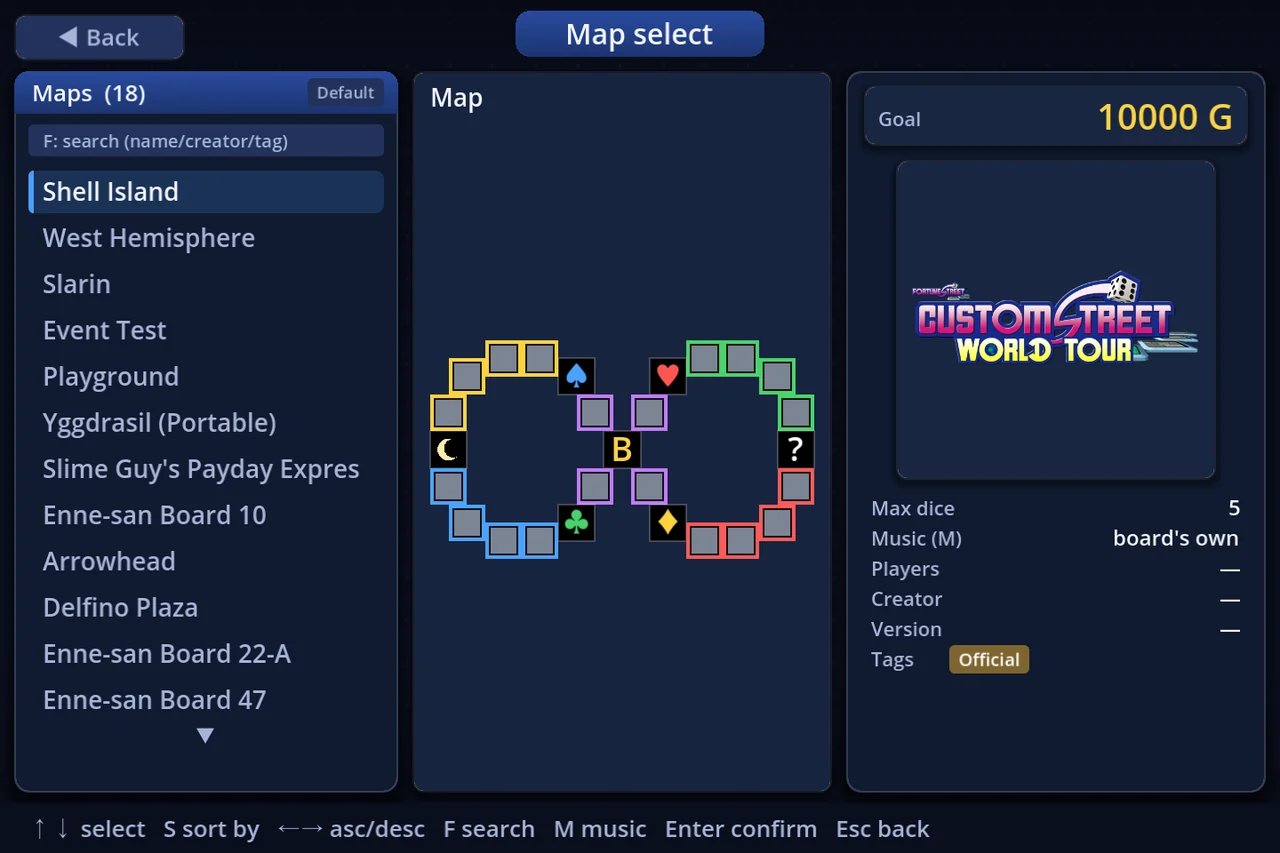
- Pick a board. Move with ↑↓ and press Enter to start (empty list? see "0." above)
- On that same board list, press R to open Rule settings — the goal amount, which casino games appear, and everything else lives there
Other → Save & quit during a match stores it, and Continue on the main menu picks it back up.
2. Reading the screen
| The board | Squares and pieces. Your own piece is marked by its colour and ring |
| The sidebar | One card per seat: rank, cash, net worth, the marks they hold, and their strongholds (districts they have cornered) |
| The minimap | The whole board at a glance |
| Messages | What just happened — money paid, a card's effect |
For more detail, the Data menu opens All status (page one is Conditions — the effects standing on every player — then everyone's assets as a table), My status, and Map (a zoomed board where every square explains itself).
3. A turn
When your turn comes round, a menu appears in the corner of the screen.
| Item | What it does |
|---|---|
| Dice | Roll and move. This is what advances the turn |
| Sell stock | Sell shares you hold (available at any time) |
| Shops | Auction, sell, buy, swap shops; remodel a vacant lot |
| Data | Map / basic data / rules / my status / all status / log / music |
| Other | Settings, this board's music, save & quit, relief (hand the seat to the CPU) |
Before you roll, arrows show which ways you can go. At a fork you choose the direction while you are walking. Then the square you land on takes effect, and the next player goes.
Some things happen just by passing through: toll booths and inns, mark squares, and the salary at a bank.
4. The squares
| Square | What landing on it does |
|---|---|
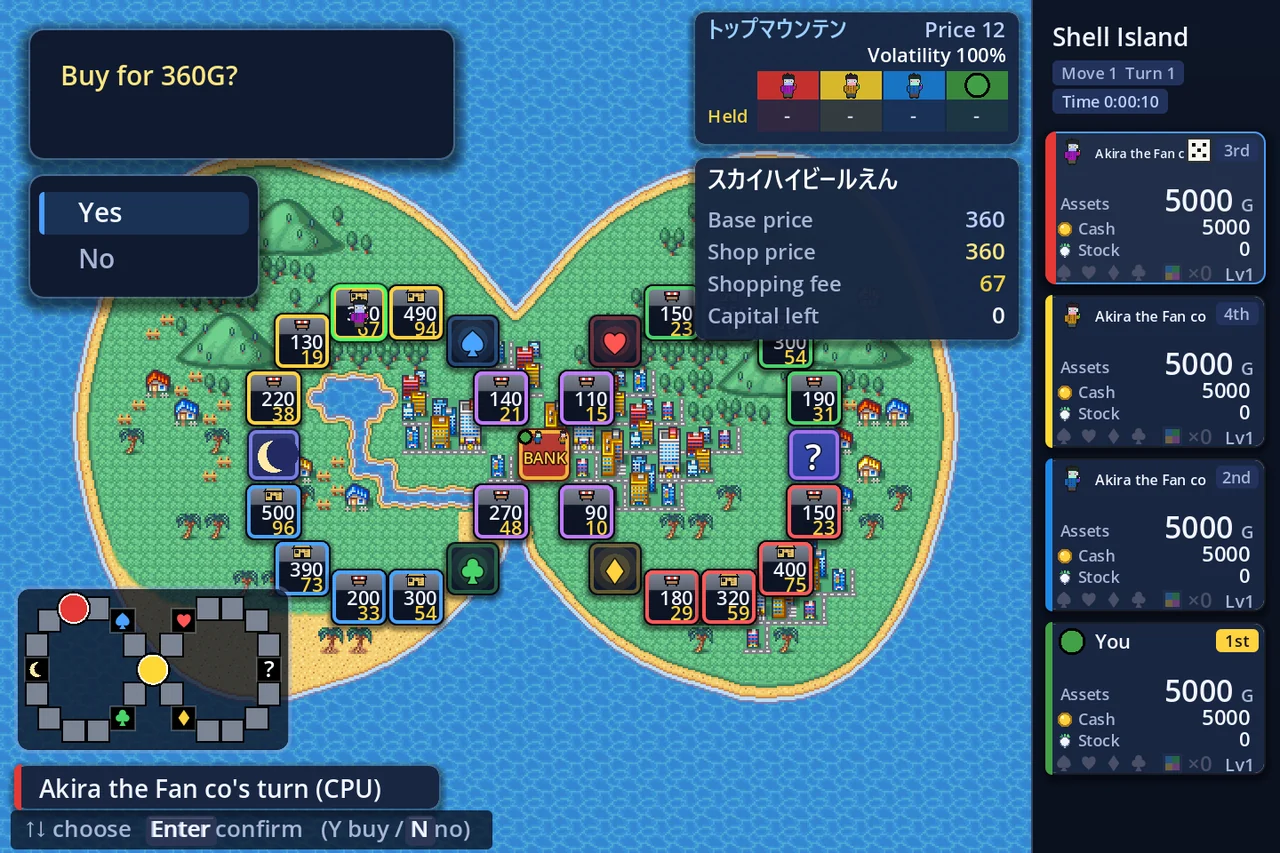
| Shop | Unowned, you may buy it. Owned by somebody else, you pay the shopping fee |
| Vacant lot | Build on it — toll booth, amusement park, tax office, my home, helipad, realtor, or a shop |
| Bank | With all four marks, you are paid your salary. With the goal in hand, you win |
| ♠ ♥ ♦ ♣ | Grants that mark. A changing mark square cycles its suit every time it is crossed |
| Chance | Draw one chance card |
| Casino | Play a minigame (which games appear is a rule setting) |
| Stockbroker | Buy shares in that district |
| Lucky | Until your next turn, you take 20% of every shopping fee other players pay |
| Super Lucky | The strong version: a 50% share |
| Dice | Roll again and keep moving |
| Rest | Your own shops close for one round (their fee is 0) |
| Warp / Cannon / Vehicle / Door & stairs | Move you elsewhere. A cannon fires you at another player |
| Switch | Rearranges the board (on boards that have them) |
Every square explains itself under Data → Map when you put the cursor on it.
5. Shops
5a. Buying
Land on a shop nobody owns and you may buy it at its shop price. From then on, anyone who lands there pays you its shopping fee.
5b. The shopping fee
The fee a visitor pays depends on
- the shop's price (which investing raises), and
- how many shops of that district its owner holds.
The more of a district one player owns, the steeper the fees — and owning all of it sends them up sharply. That is the whole game in one sentence.
5c. Investing
Landing on your own shop lets you invest in it. Investing
- raises the shop's price → raises its fee, and
- raises the share price of that district.
There is a capital ceiling on how far one shop can be built up, and the ceiling itself depends on how much of the district you hold.
5d. The 5× buyout
Landing on somebody else's shop, you may pay five times its value and take it from them. The former owner receives 60% of that (three times the shop's value). It is the strongest answer to a district somebody has cornered.
5e. Lots and buildings
Landing on a vacant lot lets you build. What you build acts on whoever lands there — or, for two of them, on whoever merely passes.
| Building | You land on it | Someone else does |
|---|---|---|
| Toll booth | Invest in your own shops | Pays the toll even when only passing, and it rises 10G each time |
| Amusement park | Invest for 100G | Pays the admission |
| Tax office | Collect 5% of your net worth | Pays 5% of theirs |
| My home | Gather everybody to you | Pays (your level × 60G) |
| Helipad | Warp to any square | Pays 10% of your next salary |
| Realtor | Buy a shop | Their own shops close for a round |
| Shop | Invest in it | Pays the shopping fee (and it counts toward the district) |
How many of each building may exist is the Build limit rule setting (shops are exempt).
6. Stock
- You may buy shares when you pass a bank, and on a stockbroker square
- A share price follows that district's shop assets, so investing pushes it up
- When anyone pays a shopping fee in a district, its shareholders take a cut
- Shares can be sold at any time from the Sell stock menu
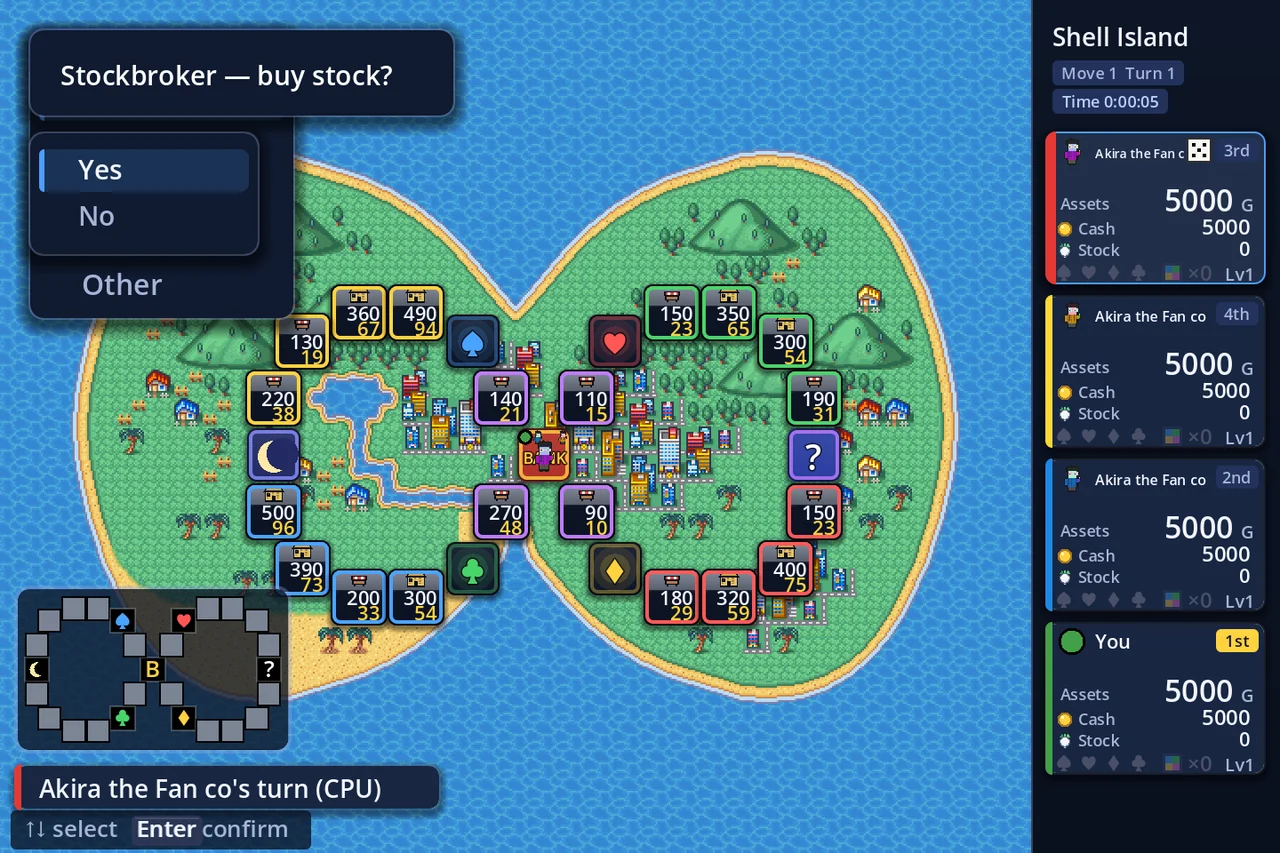
Shares count toward your net worth directly, so the plainest way to grow is to buy your own district and then invest in it. Buying into somebody else's district and riding the rise is a real strategy too.
7. Marks and salary
The board carries four mark squares — ♠ ♥ ♦ ♣. Collect all four and then reach a bank (passing through is enough) to be paid your salary.
salary = base + efficiency × level + shop assets ÷ 10The base and the efficiency belong to the board. Being paid raises your level by one and clears your marks — collect four again and the next salary is bigger.
8. Winning
Reach a bank with your net worth at or above the goal amount, and the match is yours.
net worth = cash + shop assets + the value of your sharesOnce you are over the line the screen tells you to head for the bank. All you have to do is get there — though a 5× buyout or a falling share price can take you back under it on the way.
Matches can end other ways too:
- Bankruptcies — the match ends once that many players have gone bankrupt, and the richest survivor wins
- Setting the goal to None takes the goal ending away altogether
9. When you cannot pay
If you cannot cover a fee, your holdings are turned into cash:
- Sell stock (the Sell stock menu)
- Sell a shop (Shops → Sell shop; the bank pays 75%)
- If that is still not enough, a shop of yours goes to auction
If selling everything still will not cover it, you are bankrupt: your holdings leave the board and you are out of the match.
10. Worth knowing
- Data → Rules … read back every rule this match is being played under
- Data → Basic data … the board's base salary and efficiency, the goal amount, and so on
- Data → Log … a record of what has happened
- Other → Relief … hand your seat to the CPU for a while (Backspace takes it back)
- Other → Settings … volume, CPU speed and more, without leaving the match
If something is unclear, ask on Discord.